oceanearth
The Kosrae Coral Reef Monitoring Project -- Monitoring Protocols
Background
For Participants
Get Involved
Learn More About ...
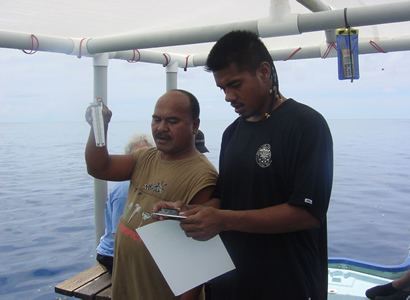
Measuring Enviromental Indicators Before Descent
The Kosrae Reef Monitoring Project was begun in 1996 employing a survey approach developed by the Australian Institute of Marine Sciences. In 1998 the data collection approach was revised to encompass procedures developed by Reef Check, an organization focused on involving recreational divers in coral reef monitoring. Modified Reef Check protocols were utilized until 2008, when they were replaced by a more rigorous and robust statistical sampling approach. In a typical monitoring session, five types of data are recorded:
Site Environment. Anecdotal, observational, historical, locational and other data are recorded on a Site Description sheet. Environmental parameters are measured including cloud cover, air temperature, and water temperature at the surface and at depth. Water samples are also taken at the surface and at depth for measurement of salinity and pH. Underwater horizontal visibility is measured by a dive team using a Secchi disk.
Fish belt transect. Five 5 m wide by 50 m long transects are photo-inventoried for fish species typically targeted by spear-fishermen, aquarium collectors and others.
Invertebrate belt transect and disease inventory. The same five transects are photo-sampled for invertebrate species typically targeted as food species or collected as curios. Evidence of coral disease and/or damage is photo-recorded.
Substrate line transect. The five transects are digitally photographed at 1.0 m intervals using a camera stand, to record the substrate types on the reef. This data is later analyzed using statistical sampling software.
Temperature Monitoring. Temperature recording devices are recovered, downloaded, and re-installed at critical monitoring sites. These devices remain underwater and record water temperature at depth between annual monitoring sessions.
Further detailed information on the project protocols can be found in the Project Participant Manual.